SEO Case Study: Early-Stage Growth for a New Holiday Accommodation Website
Launching a new accommodation website is one of the most challenging environments for SEO. Search results are dominated by global booking platforms, long-established holiday homes, and directory-style listings with years of authority behind them.
This SEO Case Study examines how a brand-new accommodation website gained early search visibility and competitive keyword traction through correct SEO foundations, entity clarity, and booking distribution strategy - without relying on paid advertising, backlinks, or ongoing SEO manipulation.
It focuses on what was done, when it was done, and how Google responded, providing a realistic view of early-stage SEO performance in a highly competitive accommodation market.
Project overview
The Client
The Bach in Mangawhai
Industry
Holiday accommodation (OTA-dominated, highly competitive)
Website project details
Website launch: 1 December 2025
Services provided
Full Website build, copy and strategic content
SEO foundations & structural SEO optimisation
Booking platforms support & channel manager setup (freeonlinebooking.com)
Google Analytics and Google Console set up
Introduction
Launching a new accommodation website in New Zealand is one of the most challenging SEO environments to enter. Search results are dominated by global booking platforms, long-established holiday homes, and directory-style listings with years of authority behind them.
This case study outlines how a brand-new accommodation website achieved early visibility, competitive keyword movement, and sustained growth through correct SEO foundations, entity clarity, and distribution strategy — without relying on paid advertising, backlinks, or ongoing SEO manipulation.
What influenced the results
SEO foundations prioritised early
Strategic copy (content written with ideal client in mind)
Booking platforms supported demand while SEO matured
The challenge
The Bach in Mangawhai launched into the market with several inherent disadvantages:
Search results dominated by Booking.com, Airbnb, Bookabach, and VRBO
Long-established competing properties with aged domains and booking histories
A brand-new website with no authority, backlinks, or history
Launching late directly into the December–January peak holiday period
The goal was not instant page-one domination, but to:
Establish clear entity recognition with Google
Achieve early traction on high-intent accommodation searches
Build a foundation for sustainable long-term growth, including direct bookings
Booking & distribution strategy (foundation work)
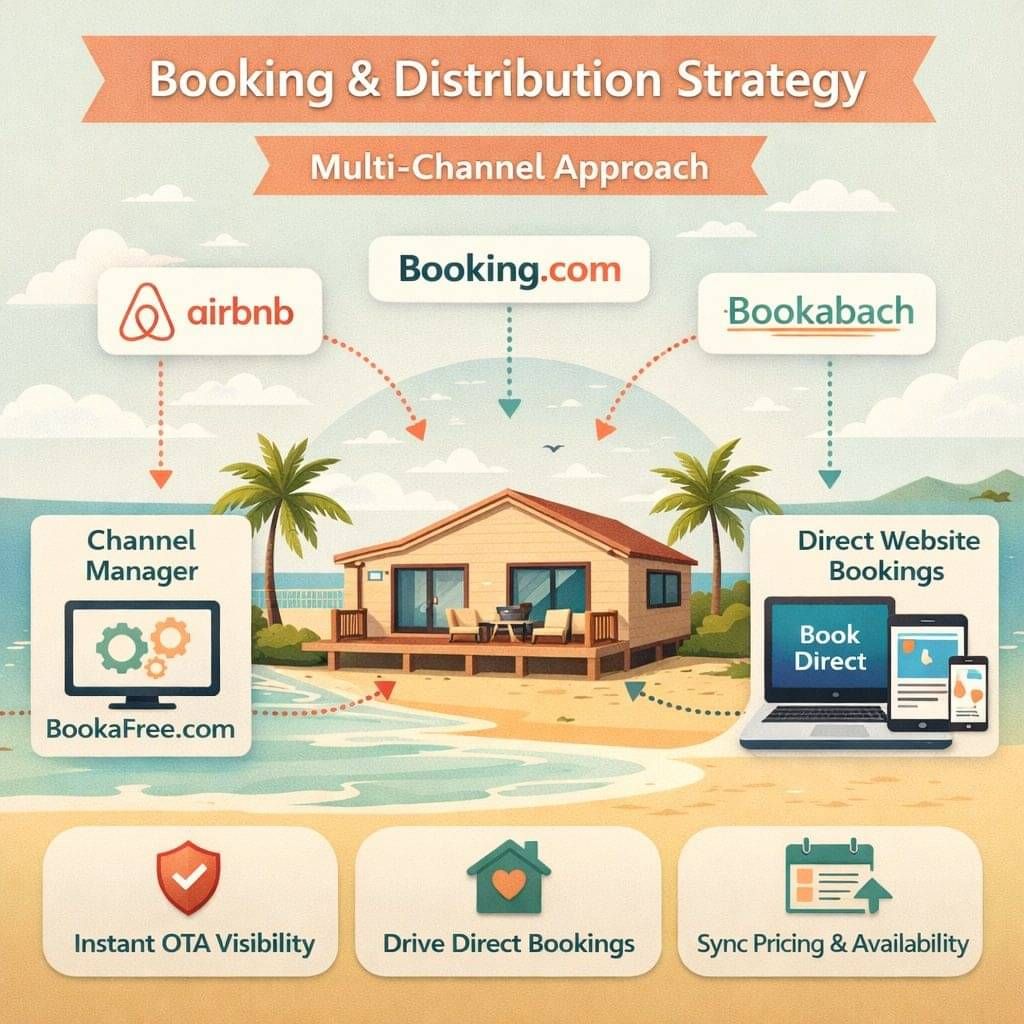
Alongside the website build, a core focus was setting up booking infrastructure and distribution to ensure the property was visible and bookable from day one.
This included:
Setup and configuration of a channel booking manager (FreeOnlineBooking)
Assistance with listing and alignment across key booking platforms:
Airbnb
Booking.com
Bookabach
Connection between the website’s direct booking system and third-party platforms to prevent double bookings and availability conflicts
Strategic intent:
Use established booking platforms for immediate visibility and trust
Support direct website bookings as a long-term objective with incentives to book direct cheaper
Maintain consistency in pricing, availability, and messaging across channels
This ensured the property could compete operationally while SEO foundations matured organically.
The Project Phases
Strategically designed over 3 phases to test SEO impacts.
Phase 1 — Launch foundations (1–20 December)
At launch, the website already included:
Clear, human-focused website copy
Well-written meta titles and descriptions
Logical page intent and hierarchy
Mobile-first design
No advanced structural SEO had been applied at this stage.
This period established a true SEO baseline, while accounting for early “warm traffic” from friends and family sharing the site.
Phase 2 — Structural SEO & entity alignment (21 December)
On 21 December, targeted SEO improvements were applied, including:
Structured data (schema)
Alignment between the website and Google Business Profile
Improved entity clarity for Google
No changes were made to:
Website copy
Page layout
Internal linking
Site structure
This allowed performance changes to be attributed specifically to machine-readable SEO improvements, rather than content or design updates.
Phase 3 — Confirmation window (1–17 January)
From 1–17 January:
No SEO changes were made
No website changes occurred
Launch-phase sharing had tapered off
This window was used to confirm whether the December gains would hold and continue organically, rather than spike temporarily.
Performance Analysis (Google Search Console)
Visibility growth (normalised by days)
Period | Dates | Days | Homepage | Impressions |
|---|---|---|---|---|
Baseline | 1–20 Dec | 20 | 234 | 11.7 |
SEO impact | 21–31 Dec | 11 | 273 | 24.8 |
Confirmation | 1–17 Jan | 17 | 466 | 27.4 |
Result: Impressions per day more than doubled immediately following the SEO updates and continued to rise through January without further changes.
Query Expansion (how Google Understood the site)
Period | Ranking Queries |
|---|---|
1-20 Dec | 16 |
21-31 Dec | 31 |
1-17 Jan | 32 |
This shows Google:
expanded how it tested the site
retained and widened visibility
continued building confidence over time
High-intent accommodation search movement
Search Query | Early Dec | Late Dec | to Mid Jan |
|---|---|---|---|
bach mangawhai | 9.7 | 3.3 | 2.5 |
mangawhai bach | 21.7 | 12.0 | 6.1 |
bach stay mangawhai | not visible | 13 | 7.8 |
the bach in mangawhai (brand) | not ranking | #1 | #1 |
These are competitive, OTA-dominated searches where movement is typically slow for new sites.
Additional high-intent search movement
(Post-21 December SEO updates, confirmed through January)
Following the structural SEO updates applied on 21 December, Google expanded testing beyond core bach keywords into broader accommodation and booking-intent searches
Several commercially relevant phrases moved from non-visibility into page-two and page-one-edge positions in the weeks immediately after the update
These included variations related to “bach stay Mangawhai,” holiday homes, and booking-style queries
While many of these terms remain OTA-dominated, rankings were retained and gradually improved, rather than dropping out of visibility
This behaviour continued through early–mid January, despite no further SEO or website changes
The pattern indicates growing entity confidence, with Google increasingly associating the site not only with branded searches, but with the wider Mangawhai accommodation landscape
For a brand-new accommodation website, this depth and persistence of query testing reflects healthy early-stage SEO traction, not isolated keyword wins
CTR behaviour (important context)
Early December CTR was elevated due to launch-phase warm traffic
CTR softened as Google widened impressions into broader, more competitive searches
This is a healthy SEO pattern, indicating expanded reach rather than declining relevance
Device & location signals
Mobile accounted for the majority of clicks and engagement
New Zealand was the dominant country by a wide margin
Visibility remained tightly aligned with local search intent
This confirmed: correct localisation, strong mobile usability, accurate intent matching
SEO Case Study Results
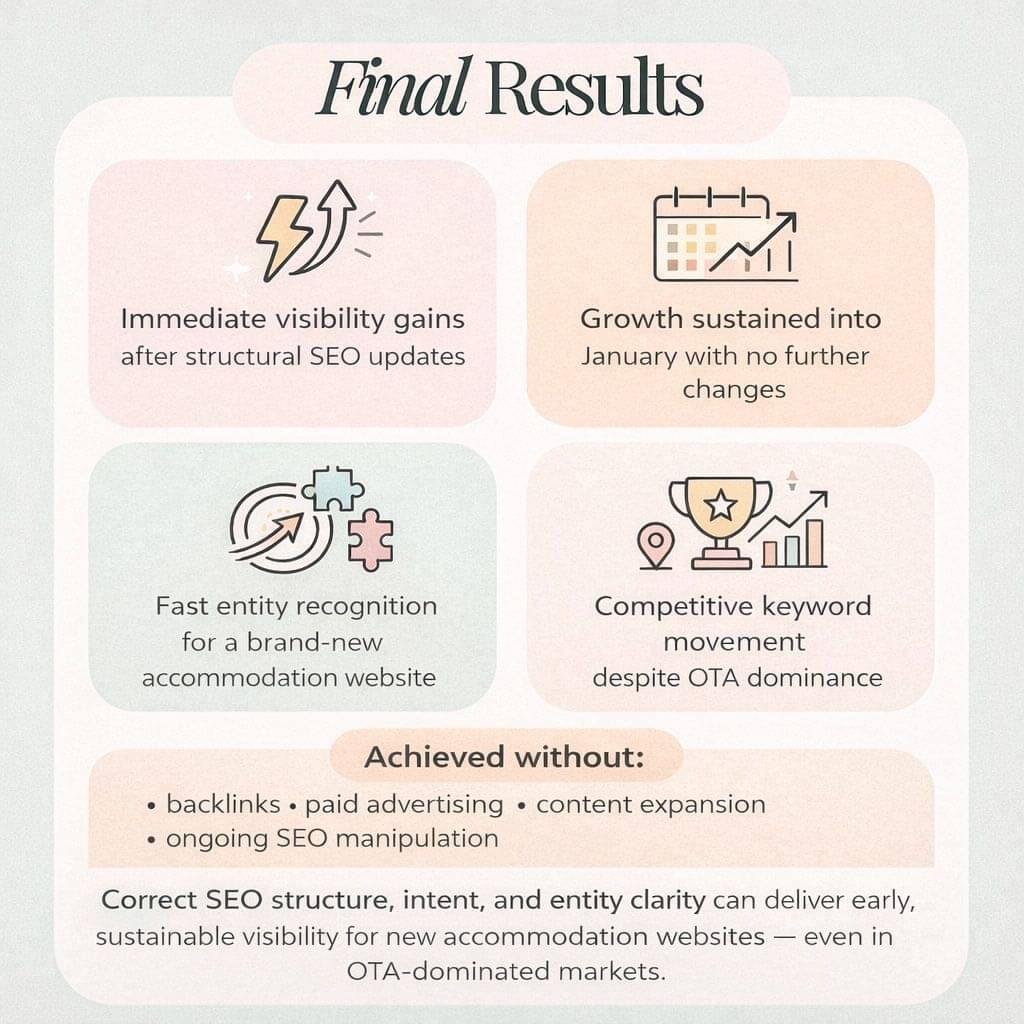
Structural SEO updates triggered immediate visibility gains
Growth was sustained into January with no further changes
Fast entity recognition achieved for a brand-new accommodation website
Competitive keyword movement occurred despite OTA dominance
Importantly:
no backlinks
no paid advertising
no content expansion
no ongoing SEO manipulation
Key takeaway:
Correct SEO structure, intent, and entity clarity can deliver early, sustainable visibility for new accommodation websites — even in OTA-dominated markets.
Looking for a website build with strategic SEO set up?



Strategic Business Support:
Organic Marketing Support & Client Attraction
Small Business Systems & Automation
Process Improvement & Workflows
CRM Set Up & Management
Small Business Websites - Design & Copywriting
Rocketspark Website Design NZ - Design Partner
Specialist Real Estate Support
Xero Bookkeeping & GST Returns
Sales Funnel & Lead Nurturing Strategies
Client Retention & Customer Experience
Small Business Resources - the Tailored Lab
Client Case Studies
Located in Auckland, New Zealand, remotely looking after small businesses worldwide.
Silverdale / Orewa Bookkeeper
Silverdale / Hibiscus Coast Web Designer